House Clearance Barbican: Sustainable Recycling & Eco-Friendly Rubbish Removal
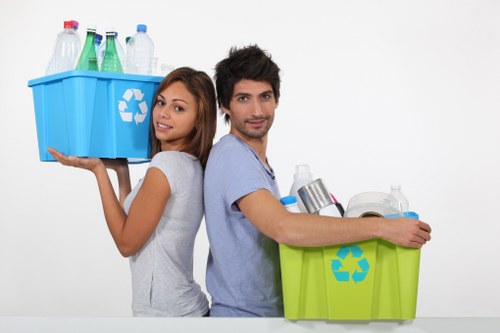 At House Clearance Barbican we prioritise an eco-friendly waste disposal area approach for every clearance. Our Barbican house clearance services are designed to minimise landfill, maximise reuse and integrate with the local boroughs' recycling schemes. We set an ambitious recycling percentage target for each job and track outcomes so every clearance contributes to a circular economy. Through careful sorting, donation and responsible transfer, we aim to make house clearances in the Barbican an example of sustainable rubbish area management.
We understand the urban context: narrow lanes, listed flats and shared estate spaces require tailored, low-impact solutions. Our city-ready teams use compact, low-carbon vans and hand-porting methods to reduce vehicle movement inside the Barbican estate. Reducing emissions is as important as reducing waste, so we combine operational efficiencies with strict waste segregation at source to keep recyclable streams clean and viable.
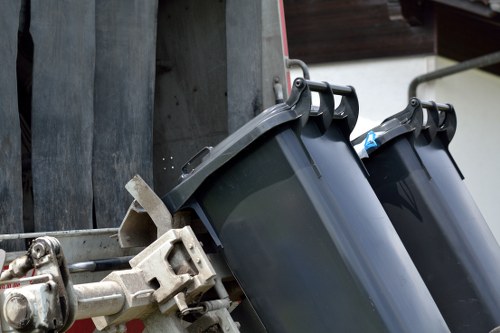 Many of the boroughs surrounding the Barbican operate a clear approach to waste separation—kerbside collections for paper, glass, mixed recycling and food waste, plus specialist take-back schemes for electricals and textiles. Our Barbican clearance activities align with these local systems: we pre-sort materials into reusable items, recyclable streams and hazardous categories, then direct each load to the most appropriate facility or partner. This awareness of the boroughs' approach helps us improve local recycling capture rates and avoid cross-contamination.
Targets, Transfer Stations and Measurable Impact
Our primary recycling percentage target is 75% per clearance within the first year, with an organisational ambition to reach 85% reuse/recycling across all Barbican house clearance projects by 2030. These figures include materials diverted through reuse partnerships and certified recycling channels. We measure outcomes for each job and report on tonnes diverted, items donated and residual waste sent to authorised treatment. Transparency drives behaviour: the more we measure, the better our sustainable rubbish area becomes.
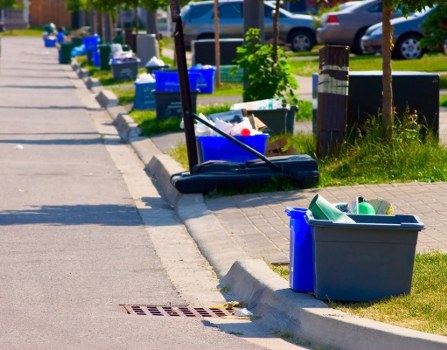 We work closely with licensed local transfer stations and community waste handling centres in the City of London and neighbouring boroughs. Where possible, recyclable loads go direct to municipal transfer stations or licensed commercial facilities that accept segregated streams—paper and cardboard, glass, metal, plastics (where accepted), WEEE (electricals) and textiles. Routing to the correct transfer station reduces double-handling and ensures materials enter established recycling channels promptly.
Our partnerships with charities and social enterprises are central to achieving high reuse rates. We collaborate with local charities and national networks—partnering with organisations such as Age UK, British Heart Foundation donation programmes and community hubs that accept furniture, small appliances and household items. These relationships keep good-quality items in circulation, support vulnerable people locally and create measurable social value alongside environmental benefit.
Low-Carbon Fleet, Reuse Routes and Recycling Activities
To support an eco-conscious Barbican clearance, our transport strategy emphasises low-emission vehicles. We operate a fleet of low-carbon vans—a mix of electric and hybrid light vans—and deploy cargo bikes for last-mile moves where estate access allows. This reduces congestion and exhaust emissions in a dense urban environment and demonstrates how house clearance Barbican services can be both effective and low-impact.
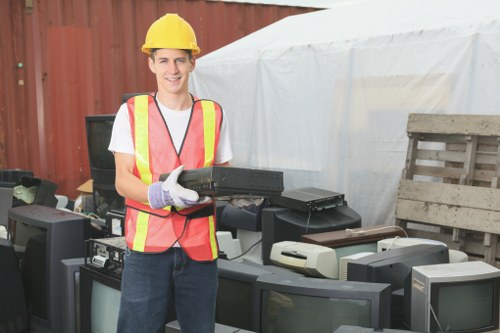 Typical recycling activity we manage on-site and through partners includes:
- Careful segregation of paper, cardboard and mixed packaging for direct recycling.
- Collection and safe reuse routing for furniture and working electrical goods.
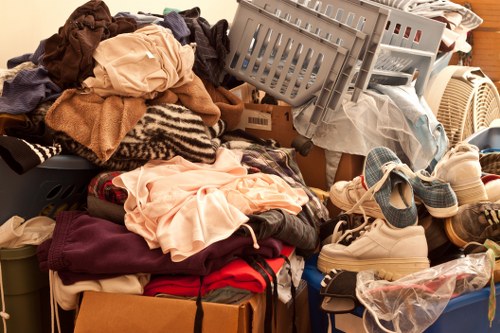
- Textile and clothing separation with charity re-distribution plans.
- Hazardous items isolated and sent to licensed handling facilities (batteries, solvents, asbestos where identified).
- Bulky waste consolidation and transfer to authorised transfer stations when recycling is not feasible.
 We also engage with local estate managers and communal recycling points to ensure that materials unsuitable for charity donation are processed through the correct municipal channels. This coordination prevents contamination of borough recycling streams and supports the City’s and adjacent boroughs’ policies on waste separation and resource recovery.
By combining measurable recycling targets, trusted transfer station routing, charity partnerships and a low-carbon fleet, our Barbican clearance model sets out a scalable path for sustainable waste management. Whether described as 'house clearance in the Barbican', 'Barbican house clearance' or 'eco house clearance Barbican', our focus remains the same: reduce waste, reuse where possible and recycle responsibly to protect local environments and support community benefit.